Showing posts with label Americana. Show all posts

Thursday, October 09, 2025

Review: Spying on the South: An Odyssey Across the American Divide

Spying on the South: An Odyssey Across the American Divide Spying on the South: An Odyssey Across the American Divide by Tony Horwitz
My rating: 5 of 5 stars

This is a book I would have enjoyed experiencing and writing. Right before the Civil War, Frederick Law Olmsted traveled around the South to gauge sentiments and thoughts and relay them to the North. The result was the book A Journey through Texas.

This book follows along the same path, to see how things and people have changed, and how peoples' views and opinions on race relations have diverged, as well as other details (what became of the Germantowns, crossing over the border, etc.). This book was written on the eve of Trump being elected, and so draw whatever parallels you wish.

The author also provides more background on Olmsted and his brother, which gave more context behind the first book.


https://4201mass.blogspot.com/

View all my reviews

Sunday, July 06, 2025

Review: A Journey through Texas: Or a Saddle-Trip on the Southwestern Frontier

A Journey through Texas: Or a Saddle-Trip on the Southwestern Frontier A Journey through Texas: Or a Saddle-Trip on the Southwestern Frontier by Frederick Law Olmsted
My rating: 5 of 5 stars

The author of this book is a New Yorker (who designed Central Park) and took a trip to Texas, Mexico, and surrounding areas in the 1850s and documented his travels. This book is everything you could want and more. An outside gives his honest opinion of the people, places and of course the prejudices of the place. The prejudices are obviously on the side of the Southern white Americans, but also the author's, which become evident.

However, the author (and his brother) are very much against slavery, and you see their impression of slaveholders go from low to extremely low, especially after encountering the Germans, who tend to be against slavery (and are surprisingly many). I found myself going through Google and Google maps to follow along, so I was very happy to hear about the book "Spying on the South: An Odyssey Across the American Divide", wherein someone follows along the same itinerary, giving an update on everything covered in this book. I look forward to reading that as well.

Also very interesting to read about crossing the border into Mexico, and seeing how race relations differed there (they pretended to be German, since they felt it was dangerous to be American there, given the acrimony). Their encounters with native Americans at the time were interesting as well, and I found myself wishing there had been more.


A very pleasant surprise to have found this book, and I'm amazed it isn't more well-known.


View all my reviews

Friday, April 11, 2025

Review: The Wapshot Chronicle

The Wapshot Chronicle The Wapshot Chronicle by John Cheever
My rating: 5 of 5 stars

This was an excellent book, telling the story of a family over the years in a way that can probably not be done anymore.

I have no idea why this was on my wishlist in the first place, but I'm glad it was.


https://4201mass.blogspot.com/

View all my reviews

Monday, July 08, 2024

Review: A Manual for Cleaning Women: Selected Stories

A Manual for Cleaning Women: Selected Stories A Manual for Cleaning Women: Selected Stories by Lucia Berlin
My rating: 4 of 5 stars

I have to be honest and say I was going to give up on this book several times. Many of the stories are extremely similar, with the same characters going through the same ordeals. So much so that it is difficult to tell certain stories apart. Of course, what this also does is create a very good sense of what Lucia Berlin's life was like (she says you can't know her life from her writing, but it certainly seems so, much more than any other author I can think of).

The repetitiveness gets to be quite a bit, as well as some of the despair and sad endings. However, dispersed throughout there are fresh, different stories (albeit never with especially happy endings, if any at all).

The language, metaphors and analogies are excellent throughout.

https://4201mass.blogspot.com/


View all my reviews

Saturday, June 01, 2024

Review: El Norte: The Epic and Forgotten Story of Hispanic North America

El Norte: The Epic and Forgotten Story of Hispanic North America El Norte: The Epic and Forgotten Story of Hispanic North America by Carrie Gibson
My rating: 5 of 5 stars

An extremely comprehensive overview of the history of Hispanic North America. Emphasis on the North, so expect detailed discussion on Spanish Florida, to Texas, California, Mexico, Cuba, Puerto Rico, etc., but very little on anything south of Mexico.

I know the expression gets thrown about, but this really should be required reading for all students in the United States.


https://4201mass.blogspot.com/


View all my reviews

Thursday, April 11, 2024

Review: Where I Was From

Where I Was From Where I Was From by Joan Didion
My rating: 5 of 5 stars

I have no interest in California, and I never really had any interest in Joan Didion. So I have no idea why this book was in my wishlist, nor why I bought it. 

However, obviously my spidey-sense instinct was working that day, since this was one of the best books I've read this year. Not really a biography, memoir or history book, but more a fascinating and thought-provoking look at Joan Didion's California, as well as a journey through the history of the state, from Western expansion to the present day, and the dreams and lies along the way. 

The whole exposé about Lakewood and the Spur posse was very interesting and new to me. 


View all my reviews

Monday, June 05, 2023

Review: Train Dreams

Train Dreams Train Dreams by Denis Johnson
My rating: 5 of 5 stars

The re-read made me appreciate this book all that much more. 

A man who basically came from nowhere with no real family, leaves behind no one, so his entire life is destined to be forgotten. But he lived a full life, becoming a husband and father, and working, traveling, etc. And, as one of the final paragraphs states:

"Grainier himself lived more than eighty years, well into the 1960s. In his time he’d traveled west to within a few dozen miles of the Pacific, though he’d never seen the ocean itself, and as far east as the town of Libby, forty miles inside Montana. He’d had one lover—his wife, Gladys—owned one acre of property, two horses, and a wagon. He’d never been drunk. He’d never purchased a firearm or spoken into a telephone. He’d ridden on trains regularly, many times in automobiles, and once on an aircraft. During the last decade of his life he watched television whenever he was in town. He had no idea who his parents might have been, and he left no heirs behind him."

Changed the rating from 4 to 5. 


View all my reviews

Wednesday, December 14, 2022

Review: Blue Highways

Blue Highways Blue Highways by William Least Heat-Moon
My rating: 5 of 5 stars

I waited until I was in the US to read this, and I'm glad I did. It's an excellent re-introduction to life in the US off the beaten track.

It was also great to follow his travels on Google Maps, from Shelbyville, KY, to Selma, AL, to Wanchese, NC (oftentimes using Streetview to see what has changed). 

Reading about places like Noname, TN, and Frenchman, NV was very interesting. As were so many of the stories and people he encountered. And stories like how Othello, NJ got its name. 


For some reason I also made note of some of the Books he mentioned when talking to people: 
Through Missouri on a mule (https://www.goodreads.com/book/show/8654504-through-missouri-on-a-mule)
The town that died laughing (https://www.goodreads.com/book/show/9862753-the-town-that-died-laughing)
Maryland's Right, Tight Isle (not on GR, but about Smith Island)

I really liked his style of writing, which made it a pleasure to read through this book. 

I thought it would be interesting to revisit some of the places he went to, and figured someone must have done so already. And sure enough, I found this: http://www.bluehighwaysrevisited.net/About-Us.html
Apparently they also wrote a book, with side by side photos. Anyway, not sure if I'll check it out, but interesting nonetheless. 

Also, just for my notes, here is his Calendar rating for finding places to get “honest food at just prices.”  

   No calendar: Same as an interstate pit stop.
   One calendar: Preprocessed food assembled in New Jersey
   Two calendars: Only if fish trophies present.
   Three calendars: Can't miss on the farm-boy breakfasts.
   Four calendars: Try the ho-made pie too.
   Five calendars: Keep it under your hat, or they'll franchise. 


View all my reviews

Friday, October 28, 2022

Review: Indian Givers: How the Indians of the Americas Transformed the World

Indian Givers: How the Indians of the Americas Transformed the World Indian Givers: How the Indians of the Americas Transformed the World by Jack Weatherford
My rating: 4 of 5 stars

Time and time again, while reading this book, I read the title of the chapter, thought "Well, this is going to be a stretch", but then was pretty much convinced by the end of the chapter. 

Some of the points ended up being a stretch (The Pilgrims didn't go from Leiden to the New World purely for profit, but also because of changes in the Netherlands, the "younger generations" becoming too Dutch, being more rural and not as used to city life, etc. But sure, profit was one of the points). I also found the connection to the industrial revolution, etc. a bit indirect. 

Some others I knew in theory, but hadn't wrapped my mind around how pervasive the native american influence actually was, such as with food. From Russian/Irish potatoes, to Italian tomatoes and zucchini, to cashews, peanuts, corn worldwide, etc. etc., these (and a lot more) all came from the Americas. 
By the way, he asserts that the Sichuan peppercorn originated with peppers in the Americas, but that sounds very odd to me. 


And some others actually surprised me. I was sure the chapter on Native American influence on liberty, democracy, and the American constitution would be a complete stretch, but the chapters made a lot of sense. The Iroquois had a league, based on majority votes and caucuses (a Native American word), which Thomas Jefferson and Benjamin Franklin, among others, quoted directly when writing about the American government structure. Everyone mentions Greek democracy, but odd that it didn't influence the world for 2,000 years until people went to the Americas. In fact, even the fact that the Iroquois league could vote new member states in was the only prior example of something similar for admitting new states into the union (rather than colonizing them and absorbing them that way). 

Extra plus, I found out this is a signed copy! I had no clue (I ordered it used from Abebooks)!


View all my reviews

Wednesday, June 30, 2021

Review: My Ántonia

My Ántonia My Ántonia by Willa Cather
My rating: 5 of 5 stars

What an excellent book. After the disappointment of 'As I Lay Dying', by Faulkner, I wasn't really sure about reading another piece of late 19th century/ early 20th century Americana. 

But I'm glad I did read it. This was enjoyable throughout. From the talk of life in Nebraska for early pioneers, to the immigrant families of Swedes, Danes, Bohemians, etc., to the change from rural Nebraska to East Coast city life. And the story itself, and Antonia.

View all my reviews

Thursday, April 08, 2021

Review: American Nations: A History of the Eleven Rival Regional Cultures of North America

American Nations: A History of the Eleven Rival Regional Cultures of North America American Nations: A History of the Eleven Rival Regional Cultures of North America by Colin Woodard
My rating: 4 of 5 stars

I loved the history here but I couldn't help disagreeing with many of the conclusions. They probably held water until around 50 years ago, but now I'm not so sure. As an example, I've lived in DC, Atlanta, Portland and Charlotte and I've found that, while these cities are all different and have their own flavors, the people there seemed to have more in common with each other than with people who might live just 30 miles away from their own city. I think the divide has changed to urban/suburban/rural now, or some variation thereof. He also argues that people naturally gravitate toward areas that suit them most, but I've moved everywhere mainly due to jobs or school. The one exception is probably Portland, but I really don't think that makes me more left-coaster. In fact, quite the opposite. 

He also says that much of the antagonism between Americans and Mexicans now (in the El Norte section) dates back to England's wars with Spain. But then how come modern England and Spain don't have the same animosity? 

Also some of his naming seemed odd. The fact that the "Yankee" region would not include New York (New Netherlands) seems rather weird. I agree with the fact, but maybe pick another name. 

However, as mentioned, the history is great. 
Interesting that John Adams basically abolished free speech "for the greater good". There was a difference between 'Freedom' and 'Liberty' back then, wherein one said everyone was free (more in the south and Appalachia, while the other said freedom was important for the community (more in the Yankee region). 

I would love an update for the post-Trump years. 

View all my reviews

Sunday, December 13, 2020

Review: The North Carolina Experience: An Interpretive and Documentary History

The North Carolina Experience: An Interpretive and Documentary History The North Carolina Experience: An Interpretive and Documentary History by Lindley S. Butler
My rating: 4 of 5 stars

The structure of this book is original: Each chapter has an introduction, broadly describing what happened during a certain time period. This is then followed by original letters and documents. 

This is a pretty effective way of going through North Carolina's history, at least for me. I was able to understand the general situation, and then read first-hand accounts of the goings-on (complete with original spelling, such as: "This towne is seated on ye river side, haveing ye clefts of ye river on ye one side..."). It does, however, seem to gloss over certain events for which there is little documentation. For example, the Tuscarora war is just mentioned several times in passing, remarking on how important it was, but it is never dealt with in detail. 

The parts about slavery, the civil war, reconstruction, and civil rights were enlightening. I can never help wondering what bias, if any, there is, given how current these issues still are. 

Some of my notes:

The treaty between the Cherokee and the United States (p. 21) was so blatantly not followed I am amazed. The treaty itself is almost equitable (the cherokee shall have a delegate to Congress, only the Cherokee who wish to leave need to. Those who leave will have all expenses covered, and a doctor shall accompany them, etc.) To think this was followed through with the trail of tears is mind-boggling. 

North Carolina never produced a farming economy comparable to the plantation system of lowcountry South Carolina or tidewater Virginia, so its relationship to slavery was ambivalent, and it pretty much joined the civil war out of solidarity with its Southern neighbors (is this true?). 

Nearly one-fourth of all conscripts in the southern army (21,348 men) came from North Carolina (p. 267)

Description of North Carolinians, 1865:
"Spindling of legs, round of shoulders, sunken of chest, lank of body, stooping of posture, narrow of face, retreating of forehead, thin of nose, small of chin, large of mouth, - this is the Native North Carolinian as one sees him outside the cities and large towns. [...]- the man who pays a tax and votes, but never runs for office; who was a private in the Rebel army, but never anything more; who hate the Yankees as a matter of course, but has no personal ill-will toward them; who believes in the Divine right of slavery, but is positive that a free negro cannot be made to work."
-Sidney Andrews (p.294)


View all my reviews

Wednesday, May 13, 2020

Review: William Howard Taft: The American Presidents Series: The 27th President, 1909-1913 (American Presidents

William Howard Taft: The American Presidents Series: The 27th President, 1909-1913 (American Presidents William Howard Taft: The American Presidents Series: The 27th President, 1909-1913 (American Presidents by Jeffrey Rosen
My rating: 4 of 5 stars

Taft is a very interesting president for many many reasons. It's too bad we only know him for being overweight (at least that's all I knew him for).

He never really wanted to be president, but always wished to be chief justice of the supreme court. So when he was elected president he approached it from a judicial (read: constitutional) point of view. He didn't care at all about politics or popularity. In a way this served him very badly. Just as generals who become president and refuse to partake in party politics tend to perform badly as a result, the same could probably be said of judges. Interesting also to see how a president who wasn't automatically campaigning for a second term wasn't praised more for it.

I guess being in between Roosevelt and Wilson doesn't help, but he is definitely someone worth reading up about.

Of course, he finally did make it to chief justice, and was a much better chief justice than president.

View all my reviews

Wednesday, April 29, 2020

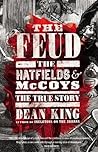
Review: The Feud: The Hatfields and McCoys, The True Story

The Feud: The Hatfields and McCoys, The True Story The Feud: The Hatfields and McCoys, The True Story by Dean King
My rating: 4 of 5 stars

If you have any interest in the Hatfield and McCoy feud you probably have to read this book. It details the entire feud, from beginning to end, and the level of detail is astounding at points (obviously I can't verify any of the information, but I'm assuming it's legit).

Still, there is no way to keep up with all the people. You have Hatfields and McCoys. Some Hatfields and McCoys live on the West Virginia side of the border, some on the Kentucky side, some from both families fought for the confederates, and some for the union, and some from both families were on either side of the feud. In addition, many have the same names (and are related in two different ways).

The story itself, however, is fascinating. This area during this time seems just as wild, of not more, than the wild west ever was.

View all my reviews

Saturday, April 11, 2020

Review: Mornings on Horseback: The Story of an Extraordinary Family, a Vanished Way of Life, and the Unique Child Who Became Theodore Roosevelt

Mornings on Horseback: The Story of an Extraordinary Family, a Vanished Way of Life, and the Unique Child Who Became Theodore Roosevelt Mornings on Horseback: The Story of an Extraordinary Family, a Vanished Way of Life, and the Unique Child Who Became Theodore Roosevelt by David McCullough
My rating: 3 of 5 stars

First of all, this book is excellent. It portrays Teddy Roosevelt with all his eccentricities, his privileged upbringing and his tragedies (losing both his wife and mother to different diseases right after his daughter is born, on February 14th). It also discusses his family, the people around him and the times he was living in.

Unfortunately, this is not a biography, but just a biography through his 29th year. It only ever mentions his presidency and Nobel peace prize (and mayorship) in the afterword, and just very briefly. Having the subtitle "The story of ... the unique child who became Theodore Roosevelt" isn't exactly clear about not covering his adulthood.

So this just seemed misleading. Of course, calling it Theodore Roosevelt's life up to 29 years of age, or Teddy's youth, might not sell as many books.

Now I'm wondering if I should tackle another biography to actually read about his presidency, or just continue on to Taft.

Anyway, 5 stars for content. 1 star for being misleading. 3 stars overall I guess.

View all my reviews

Friday, April 03, 2020

Review: As I Lay Dying

As I Lay Dying As I Lay Dying by William Faulkner
My rating: 2 of 5 stars

I didn't really enjoy this at all. There were around 15 different narrators, it was all stream of consciousness, a tad non-sensical and pretty depressing. I had to google the plot to figure out if I was missing something.

Maybe a lot of this was the point, since it forces you to be very involved and decipher what you're reading rather than just read it passively. Or you could just opt to toss it aside and read another book...

View all my reviews

Wednesday, March 11, 2020

Review: President McKinley: Architect of the American Century

President McKinley: Architect of the American Century President McKinley: Architect of the American Century by Robert W. Merry
My rating: 4 of 5 stars

McKinley is probably the most underrated presidency thus far (n.b., I wrote "presidency", not "president", which I still think is Garfield), especially as regards international expansion (colonialism?). Cuba, Puerto Rico, Hawaii, Guam, the Philippines and Samoa were all added/conquered during his presidency. Not to mention the meddling with China along with the Europeans and Japanese. To his credit, he disavowed colonialism, and actually tried to promote independence and elections in Cuba and the Philippines. NOT to his credit, he did no such thing in Hawaii, Puerto Rico or Samoa.

To be fair, it seems as though if the US hadn't taken control of Hawaii, Japan almost certainly would have (much like they did with Okinawa), with 30,000 Japanese immigrants already in Hawaii. And apparently Germany and Britain were also eyeing it.

This biography was excellent, in that it delved into much detail with regards to his presidency. In fact, I probably didn't need to know the maneuverings behind each and every bill and every trip he took to Canton. However, in some areas it seemed remarkably lacking. The taking over of Samoa only gets one paragraph and is never mentioned again.

Also, Mckinley's assassin, Czolgosz, isn't even mentioned until 10 pages before the end of the book (aside from a brief dramatic cameo in the introduction). It says he hung out with anarchists and was inspired to assassinate McKinley based on a speech by Emma Goldman, but almost nothing else about her. I can't understand why these points would be basically brushed aside.


Some interesting notes I took:

During the Spanish American war, combat deaths for Americans were only 281, while nearly 2,500 died from diseases (p. 320)

Interesting also to note how protectionist the Republican Party was back then. "Since its inception, the Republican Party, Mckinley's party, had been the party of protectionism" (p. 7). At some point it became the party of open markets and free trade, although now I guess it has come full circle back to protectionism.

Another interesting passage:
"Indeed Republicans were the progressive party, comfortable with the application of federal power in behalf of major national goals: protecting the voting rights of blacks..." (p. 106) Times have changed.

Apparently Mckinley was the first president to make his own campaign speeches (not write, actually make them, which wasn't done back then).

The author also doesn't seem to like Roosevelt, who apparently downplayed McKinley during his presidency, and presumably this is why we barely remember him nowadays. He may be right.


Edit:
After reading up a bit more on Leon Czolgosz and Emma Goldman I'm all the more perplexed as to why they didn't feature more in the book. Czolgosz had a history of mental illness and, while he identified as an anarchist, he wasn't accepted in anarchist circles. In fact, he showed up once at Goldman's house asking odd questions, so they assumed he was a government infiltrator and sent around notices to other anarchists to beware of him.

Once he was arrested he stated Goldman's speech inspired him, so Goldman was arrested and held for 2 weeks, but no ties were found between her and Czolgosz, so she was released. After release, however, she wrote an article comparing Czolgosz to Brutus, and so she was shunned not only by the public, but by other anarchists as well, and withdrew into seclusion.

At Czolgosz's trial, he refused to talk to his lawyers, so Loran L. Lewis, his defense attorney, made a 27 minute address, not defending Czolgosz, but defending his own status in the community (he didn't want to be villified for defending Czolgosz).

View all my reviews

Monday, February 10, 2020

Review: American Gods

American Gods American Gods by Neil Gaiman
My rating: 3 of 5 stars

Major spoilers here.

Wow. Really not sure what to make of this. I love the premise, and the general idea throughout the book, although I kept feeling more could have been done with it. For the number of Norse gods throughout, and even the appearance of ancient Egyptian gods, it seemed odd to have barely anything from Ancient Greece or Rome, or even old Chinese and Hindu gods.

The prose is very Neil Gaiman, which I always like. And the story seems full to the brim with symbolism, clear up to the protagonist, the son of God, being hung up, pierced in his side, and resurrected thanks to Easter.

I did not see the twist with Hinzelmann in the end.

View all my reviews

Thursday, November 14, 2019

Review: Midnight Son

Midnight Son Midnight Son by James Dommek Jr.
My rating: 3 of 5 stars

Basically an extended podcast, but pretty interesting. A lot of information about the Inupiaq and their beliefs and way of life, as well as of life in the small villages of Alaska.

Having said that, the story seemed like it could have been stronger. He didn't even speak to Teddy directly, and I'm not sure what the final outing he took accomplished.

Also it is odd that Teddy believes he should be judged by peers from his village, since it was peers from his village that he shot at, so I'm not sure how much better that would be.

Anyway, definitely worth the free price, and worth the time just for the information re: Alaska, Inupiaqs, and obviously Inukuns.

View all my reviews

Tuesday, October 22, 2019

Review: A Walk in the Woods: Rediscovering America on the Appalachian Trail

A Walk in the Woods: Rediscovering America on the Appalachian Trail A Walk in the Woods: Rediscovering America on the Appalachian Trail by Bill Bryson
My rating: 3 of 5 stars

It's always fun to read a Bill Bryson book. The story itself is 100% anecdotal, interspersed with real information here and there almost as an aside. But it all works well, and makes reading about something you didn't think you had any interest in quite interesting.

I would advise people to read this book, and then read "Just Passin' Thru" to read more about the AT from the point of view of true hikers.

3.5 stars

View all my reviews